MWC 2025
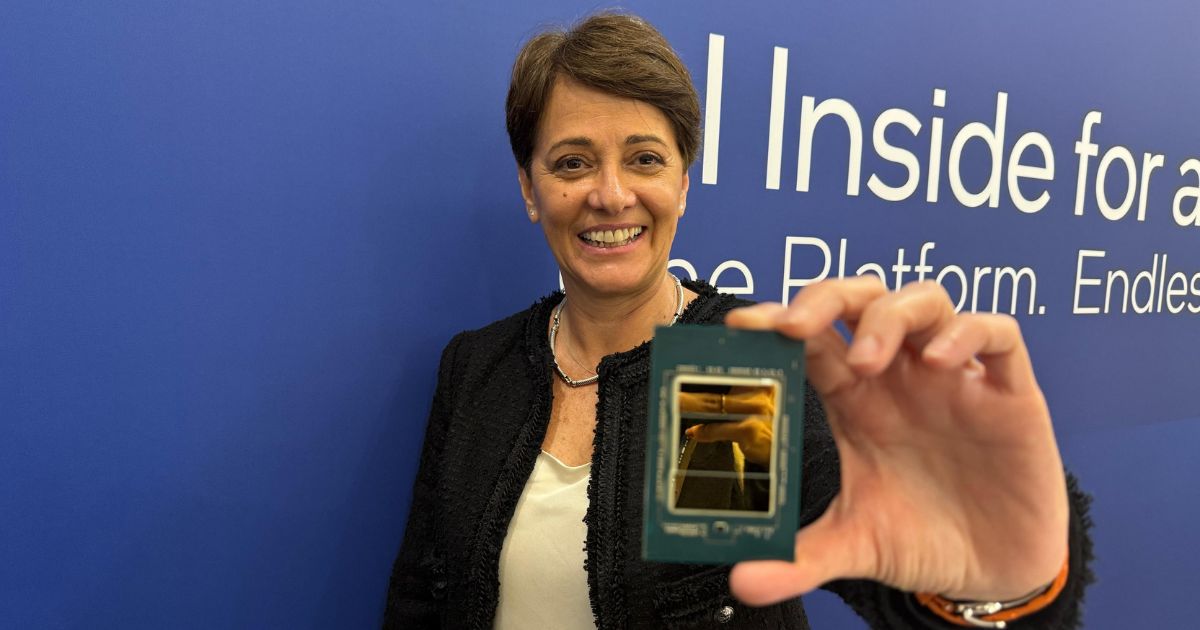
Powered by AI, Intel's Xeon 6 is a game-changer for virtualization
During the first day of MWC 2025, which is taking place in Barcelona*, Spain, Intel reinforced its position as a leader in the network infrastructure market with the Intel Xeon 6 SoC. According to Cristina Rodriguez, Intel vice president and general manager of the Wireless Access Networking Division, the chip will revolutionize virtualization by combining artificial intelligence (AI), energy efficiency and total cost of ownership (TCO) optimization.
At the heart of the data center, the technology keeps operations exclusively in the Central Processing Unit (CPU), without relying on dedicated GPU Graphics Processing Units (GPUs) – a novelty that becomes a key factor in Intel's strategy. The CPU is the main processor of a system, responsible for executing general commands and calculations, while the GPU is optimized for parallel tasks and is usually used for graphics processing and artificial intelligence.
“When you are at the edge, in the Radio Access Network (RAN), the necessary functions can be performed with just the CPU, reducing complexity and costs,” she says. The RAN is the part of the telecommunications infrastructure that connects devices, such as cell phones and IoT, to mobile networks, transmitting and receiving data. She also defined the Xeon 6 SoC as a “game changer for data center virtualization” to strengthen operators’ confidence in the CPU-only approach to edge computing – a distributed computing model that processes data closer to the source, reducing latency.
“We are very excited, as we have been manufacturing CPUs for a long time and have the largest ecosystem in the market. This is essential to ensure that each new generation of processors brings a significant return on investment (ROI) for our customers,” she highlights. “We expect the solution to further reinforce confidence in the virtualized network and that the incorporation of AI will become a critical differentiator for the future,” she adds. According to the executive, the Xeon 6 brings innovations in AI inference and video processing capacity, in addition to offering greater security with Intel Software Guard Extensions (SGX). The Xeon 6 SoC also features a 70% improvement in performance per watt compared to previous generations and offers up to 14 times more media transcoding capacity.
At Intel's booth at MWC, demonstrations show how the processor can be used in advanced AI applications, including an AI-based inference system for workplace safety monitoring, checking whether employees are wearing mandatory safety vests — all processed directly at the edge. “It was very important to reduce TCO by allowing us to scale up to 72 cores in a single rack. Before, where they needed two servers, now they only need one. This represents significant savings,” she points out.
Intel revealed that the Xeon 6 has been rapidly adopted by major telecom partners for the evolution of 5G. Since the previous version of the product was launched in June 2024, partners have seen a 3.2x increase in performance and a 3.8x improvement in performance per watt. With the introduction of Intel Infrastructure Power Manager, launched at MWC last year, it has been possible to reduce power consumption during operations by 60%. Alex Quach, Intel’s vice president and general manager for the Wireline and Core Network Division, says that infrastructure efficiency, energy savings and uncompromising performance are key criteria for communications service providers, which is why the technology has gained traction. “Our partners have accelerated the adoption of Xeon 6 and are immediately delivering these benefits to their customers.”
Strategic partnerships...The new processor is being deployed by several global companies, including Verizon, Dell Technologies, Ericsson, HPE, Nokia, NEC, Samsung and SK Telecom. These companies are using the technology to boost their infrastructure, reduce costs and improve energy efficiency.
Ericsson, for example, has integrated the Xeon 6 with E-cores into its 5G core application portfolio, achieving a 3.8x improvement in performance per watt. Nokia has reported a 60% reduction in runtime power consumption on commercial servers, while SK Telecom has announced an estimated 32% per day of CPU power savings in its traffic model.
mundophone




No comments:
Post a Comment