TECH
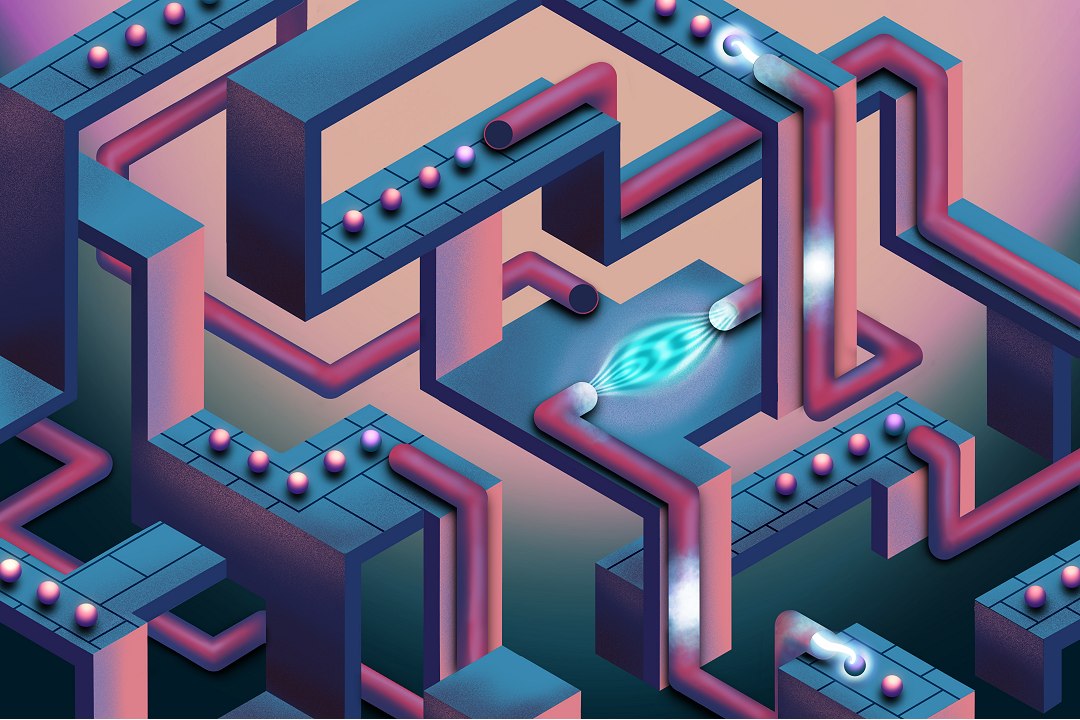
Quantum supercomputer...In a milestone that brings quantum computing closer to practical use on a large scale, scientists at the University of Oxford in the United Kingdom have demonstrated the first instance of distributed quantum computing.
Using a photonic network interface, they connected two separate quantum processors to form a single, fully connected quantum computer, paving the way for previously out-of-reach computational challenges and reducing the difficulty of cramming ever-increasing numbers of qubits into each quantum processor.
The breakthrough has to do with the "scalability problem": A quantum computer powerful enough to deliver on all the technology's promises would have to be capable of processing millions of qubits. Packing all those processors into a single device, however, would require a massive machine.
In this new approach, tiny quantum processors are connected by light, allowing computations to be distributed across the network. In theory, there is no limit to the number of processors that can be on the network.
The scalable architecture is based on modules that contain only a small number of trapped ion qubits, also known as atomic qubits. They are connected using optical fibers and use light – photons, rather than electrical signals – to transmit data between them. These photonic links allow qubits in separate modules to be quantumly entangled, allowing quantum logic to be executed between modules using the phenomenon of quantum teleportation.

Quantum communication by teleportation...The two crucial phenomena used to create this distributed quantum computer are entanglement and teleportation. Entanglement allows two particles, such as a pair of photons, to remain correlated even when separated by large distances. This allows them to share information without having to physically travel.
Quantum teleportation, on the other hand, allows quantum information to be transferred over long distances almost instantaneously using entanglement.
While quantum teleportation of states has been demonstrated in a number of different situations, this is the first demonstration of quantum teleportation of logic gates (the building blocks of an algorithm) across a network link. According to the researchers, this could lay the foundation for a future quantum internet, where distant processors could form an ultra-secure network for communication, computation and sensing.
"Previous demonstrations of quantum teleportation have focused on the transfer of quantum states between physically separate systems. In our study, we use quantum teleportation to create interactions between these distant systems. By carefully tailoring these interactions, we can perform quantum logic gates – the fundamental operations of quantum computing – between qubits housed in separate quantum computers. This advance effectively allows us to 'connect' separate quantum processors into a single, fully connected quantum computer," explained Professor Dougal Main.
The concept is similar to how traditional supercomputers work, which are composed of smaller computers linked together to achieve greater capabilities than each separate unit. This strategy circumvents many of the engineering hurdles associated with cramming ever-increasing numbers of qubits onto a single processor, while preserving the delicate quantum properties required for accurate and robust computations.
References--Article: Distributed Quantum Computing across an Optical Network Link
Authors: D. Main, P. Drmota, D. P. Nadlinger, E. M. Ainley, A. Agrawal, B. C. Nichol, R. Srinivas, G. Araneda, D. M. Lucas
Journal: Nature


No comments:
Post a Comment