TECH
Stanford University Scientists Discover Manganese-Palladium-3 Compound Makes Memory Modules Faster
Scientists at Stanford University have reported the creation of a new material that will help increase the creation of RAM with greater speed and energy efficiency. The compound has the formula MnPd3 (manganese-palladium-3). It will allow you to create fast memory modules that support training artificial intelligence systems locally rather than on remote servers.
The authors of the project believe that humanity is moving from the Internet era to the AI era, and launching AI algorithms on the periphery – on a home computer, smartphone or even a smart watch – becomes an urgent task. This will allow, for example, to detect signs of health problems or recognize natural speech, but such applications require more efficient hardware than existing ones, including faster RAM.
In this case, we are talking about SOT-MRAM memory type (spin-orbit torque MRAM) – magnetoresistive random access memory with data writing using spin-orbit torque. It relies on an internal property of electrons – their spin. Spin can be described as something like a basketball spinning on an athlete's fingertip. But since the electron is a charged particle, it turns into a tiny magnet as it spins, polarized along the axis of rotation – going back to the basketball analogy, this is the line that continues the line of the athlete's finger. By directing these lines up or down, you can get the representation of zeros or ones, forming bytes of computer data into an array. At the same time, this memory, unlike random access memory currently used everywhere, is non-volatile.
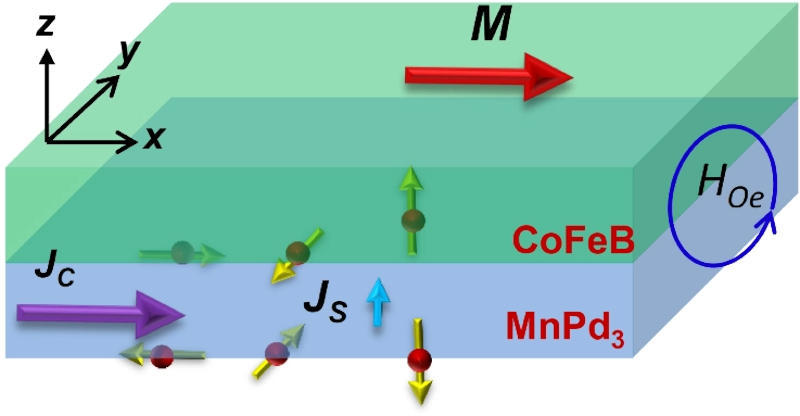
In SOT-MRAM memory modules, a spin polarized current flows through a layer of spin orbit moment (SOT) material, which causes spin switching of particles in an adjacent magnetic material. Ideally, properly selected substances provide data logging simply by changing the current in the SOT layer. However, finding a suitable material for such a layer is not easy, and again an analogy is needed. If we take a slice of bread on a plate as a frame of reference and place the X and Y axes along its edges, then when current flows along the X axis, most materials have spin polarization along the Y axis, while maximum data density can be achieved when polarized along the Z axis – an axis that continues the line perpendicular to a toothpick inserted in a slice of bread. To get around this limitation in the general case, it is achieved using an external magnetic field.
The MnPd3 compound obtained by American scientists has the necessary properties – its internal structure is devoid of crystalline symmetry, which would force all electrons to align their spins along a line. With this material, the researchers demonstrated polarization switching in the Y and Z directions without the need for an external magnetic field – it can even be aligned in the X direction, the scientists specified, although this nuance was not included in the main work.
In addition to the asymmetric crystalline structure, MnPd3 has a number of other properties that will help to quickly introduce it into the mass production of SOT-MRAM modules. In particular, it resists annealing (400°C for 30 minutes) produced during electronics production, and its layer is created through magnetron sputtering, a process already used in the production of other components for data storage. In other words, its introduction into production will not require new tools or new methods – the material has new properties, but it fits perfectly with modern production technologies. Scientists are already working on prototype manganese-palladium-3 SOT-MRAM modules that can be integrated into real devices.
Image source: news.stanford.edu




No comments:
Post a Comment