TECH
Swiss scientists create paper battery that is activated by water
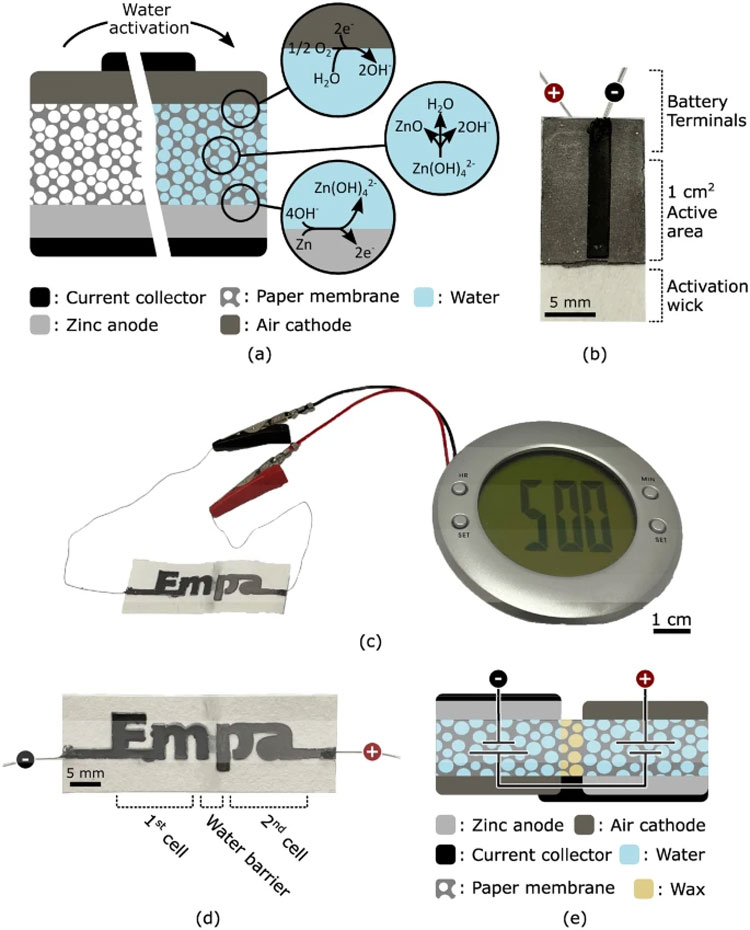
The prototype battery is a strip of plain paper coated with common table salt. A layer of graphite flakes has been added to one side of the paper – this is done using a specially made ink. Thus, the battery receives a cathode. An anode in the form of a layer of a mixture of graphite and zinc is applied to the back of the paper. To start the redox reactions in the battery, which will lead to the generation of electric current, just put a few drops of ordinary water in it.
The water dissolves the salt and creates ionic conductivity in the battery's paper layer. In fact, this is equivalent to pouring electrolyte into a battery. The zinc oxidation reaction begins at the anode, which releases electrons. If a load is connected to the battery's contacts, electrons will travel through the wires to the cathode, where a reduction reaction will begin with the capture of oxygen from the air. This starts a cycle of redox reactions, generating current as long as there is zinc at the anode to support the reactions, or until the water dries up.
Researchers at the Swiss Federal Materials Science and Technology Laboratory (EMPA) performed a proof of concept by fabricating two elements in the proposed way and connecting them in series to increase the voltage. From two drops of water, the element powered the electronic alarm clock for about an hour. A single cell was activated 20 seconds after water application and had a stable voltage of 1.2 V for one hour without load. When the battery ran dry, the scientists added a few more drops and extended the battery life for another hour or so, although upon reactivation, the open circuit voltage was only 0.5V.
The developers believe that these batteries can be activated automatically in high humidity conditions, or it will be possible to create a battery design for normal use after adding water. Engineers will certainly be able to figure out how to prevent the battery from drying out ahead of time. It works as long as the zinc remains in the anode. Thus, it is easy to calculate the lifespan of these batteries and print them strictly to keep power within specified time limits, which is not possible with alternative technologies, for example similar air-to-metal batteries in implementation.
Image source: EMPA



No comments:
Post a Comment