MICRON
Brand launches world's first 232-layer 3D NAND flash chip(1Tbps/chip)
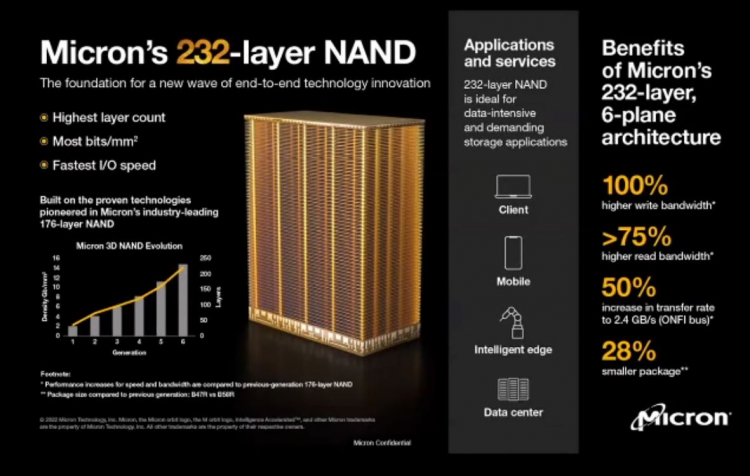
Micron has announced the start of shipments of 232-layer NAND TLC 3D flash memory chips, which have the highest density on the market – the volume of a single chip can reach 1 Tbit. In addition to significantly increased density, the new 232-layer 3D NAND TLC flash chips deliver up to twice as fast write speeds and up to 75% faster read speeds than previous generation chips.
As shown in the image below, the increased density allowed Micron to reduce the package volume of its 232-layer NAND TLC 3D flash chip by 28% compared to previous generation chips. This can be useful when producing, for example, the same smartphones and microSD memory cards.
Up to sixteen 232-layer 3D NAND TLC flash memory chips can be combined into an 11.5×13.5mm package, thus achieving a 2TB chip that is one-third the size of a US postage stamp. With the densest layout, up to 14.6Gb of information can be recorded per 1mm2, which is 30-100% more than competing products supplied to the market. According to Micron, one of these chips can store 340,000 hours of 4K video.
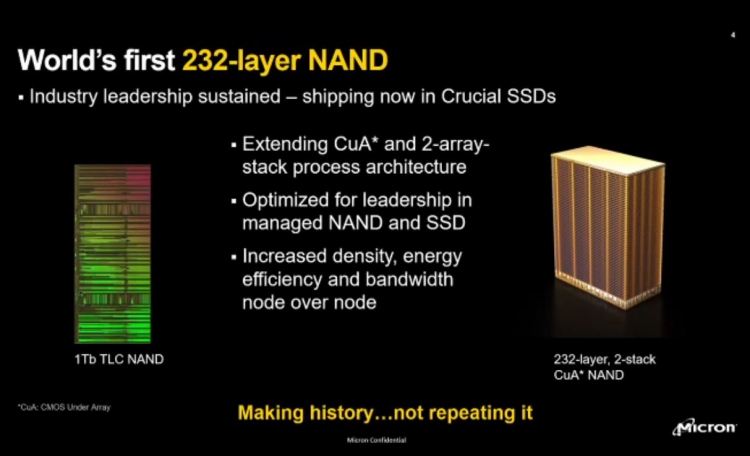
As before, Micron uses its CMOS under array (CuA) technology in new flash memory chips, but now in the sixth generation, to increase density by placing CMOS under the cell array. The company also adopts a dual-stack flash design. This means that each finished die is made up of two 116-layer dies that are stacked together in a process called stacking. The manufacturer also cites the use of new materials and processes to create holes in the chip with high density, which also affected the overall chip density.
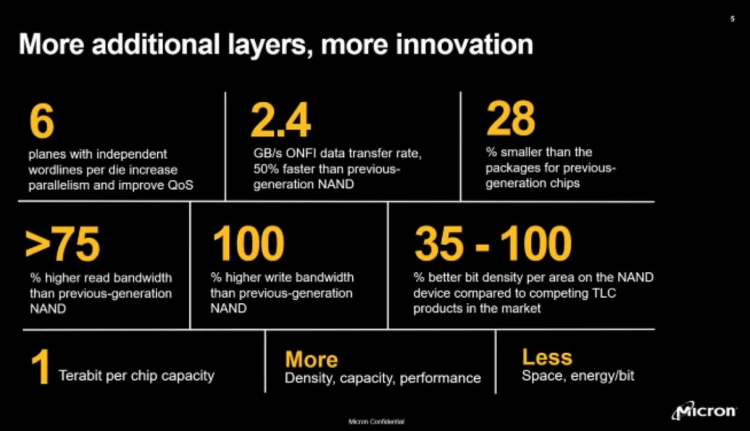
The impressive performance of Micron's new flash memory chips comes from a new six-plane architecture, a first for 3D NAND TLC memory. A plane is an area of a flash memory chip that independently responds to I/O requests, similar to how each CPU core can perform operations in parallel. The greater the number of planes, the greater the performance.
The previous generation of Micron flash memory used a four-plane architecture. The transition to six planes allowed a 50% increase (up to 2.4 GB/s) in data transfer rate via the ONFI 5.0 interface, generally increasing the memory chip bandwidth. At the flash chip package level, this resulted in a twofold increase in write performance and a 75% increase in read speed compared to the previous generation, which featured 176-layer chips, says Micron. True, this is only in theory. In practice, everything is much more complicated. After all, that doesn't mean that solid-state drives will appear on the market anytime soon, twice as fast as current ones. The problem is that SSD performance is also affected by other factors like memory controller and interface.
According to Micron, the addition of additional planes also has a positive effect on the quality of data transfer and delays in write and read operations, but the manufacturer has not yet published more data on the matter. The logic of the new 232-layer Micron 3D NAND TLC flash memory chips supports the new NV-LPPDR4 interface with lower power consumption – the power cost per bit is reduced by up to 30% compared to the previous generation interface. In other words, the new chips are more energy efficient. However, the company again does not share specific details and examples.
Micron also doesn't say anything about the reliability of the new flash memory chips. However, the new 232-layer chips can be expected to match the previous generation flash memory chips in this indicator. Remember that the reliability index is calculated in Program/Clear (P/E) cycles (program/clear). For example, the previous generation of Micron TLC memory in consumer drives is typically rated for 1K-3K and 5K-10K P/E cycles for enterprise-class SSDs. The final score is also affected by the type of error correction algorithm (ECC) used. However, you can expect the same level of reliability as 232-layer TLC memory chips.
The company notes that it has already started deliveries of new 232-layer NAND TLC 3D flash memory chips to OEMs, as well as new Crucial SSDs based on them (models not specified). Micron recently launched production of new chips and will continue to ramp up production throughout the remainder of 2022.
Image source: Micron




No comments:
Post a Comment