TECH

“Cooling without electricity or water”: DGIST develops “self-cooling film” for thermal management in AI-era electronic devices
A research team led by Professor Seong Kyun Kim of the Department of Physics and Chemistry at DGIST (President Kunwoo Lee) has developed a next-generation “passive cooling film material” that utilizes moisture in the air to cool electronic devices —no water or electricity is required. The technology is drawing attention as a promising, environmentally friendly solution to thermal management challenges in AI data centers, mobile devices, and electric vehicle (EV) batteries, which consume substantial water and electricity.
Recent advances in AI technology have driven the surge in data centers, and securing the electricity and water resources required for their thermal management has emerged as a global challenge. Likewise, mobile devices and EV batteries require technologies that can efficiently dissipate heat within confined spaces. However, conventional active cooling methods that operate pumps or fans require electrical energy and a coolant (water), and their complex systems entail significant maintenance costs.
Accordingly, passive cooling technologies that require no external energy input—particularly, evaporative cooling technologies that utilize airborne moisture—have emerged as an alternative. However, as most conventional hygroscopic materials—that is, materials that absorb moisture—are rigid crystalline solids, they do not adhere firmly to the surfaces of electronic devices, and induce corrosion. These are significant limitations to their commercialization.
Professor Seong Kyun Kim’s research team achieved a major breakthrough in addressing these limitations by combining “nanocellulose,” which possesses excellent moisture storing capacity, with organic ionic molecules with robust hygroscopic properties to synthesize a novel flexible, adhesive film material.
The developed material maintains strong adhesion and flexibility even when completely dry, enabling firm, gap-less adherence to various electronic device surfaces, including metals, semiconductors, and glass. Even in dry environments, it absorbs and stores substantial airborne moisture, which evaporates when the device generates heat during operation, thereby lowering the surface temperature in real time. A key advantage of the material is that it does not induce corrosion despite containing moisture, enabling direct application to device surfaces without any additional coating.
When the research team tested the film under actual conditions of continuous electronic device operation, the developed film material demonstrated exceptional cooling performance, stably reducing the device’s surface temperature by up to 18.2°C (from 72.3°C to 54.1°C) for more than 12 hours.
“The significance of this study goes beyond merely developing an environmentally friendly material. It simultaneously addresses multiple limitations of conventional passive cooling materials, including corrosiveness and insufficient flexibility and adhesion,” explained Professor Seong Kyun Kim of the Department of Physics and Chemistry at DGIST.
This research was led by doctoral student Hyeondo Kim of the Department of Physics and Chemistry, with support from the Ministry of Science and ICT’s Individual Basic Research Program and the DGIST International Joint Research Program. The findings were published in the internationally renowned journal Small Structures in September 2026.
A film has been developed that can cool electronic devices without using electrical energy or separate refrigerants. It is flexible and transparent, and in a dry state adheres well to metal, semiconductor, and glass surfaces, drawing attention as a supplementary cooling material that could help solve thermal management issues in artificial intelligence (AI) data centers and electric vehicle batteries.
Daegu Gyeongbuk Institute of Science and Technology (DGIST) announced on the 6th that a research team led by Professor Kim Sung-kyun of the Department of Chemical Physics has developed a next-generation "passive cooling" film material that autonomously dissipates heat from electronic devices by using moisture in the air. The research results were published on September 17 (local time) in the international journal "Small Structures."
A common challenge for data centers, mobile electronic devices, and electric vehicle batteries, all of which are seeing growing demand, is heat management. Conventional active cooling methods that operate pumps or fans require electrical energy and water as a refrigerant, and their complex equipment results in high maintenance costs.
Among passive cooling technologies that require no external energy input, evaporative cooling, which utilizes moisture in the air, is emerging as an alternative. However, existing hygroscopic materials that readily absorb moisture are often rigid solids, making it difficult for them to closely conform to electronic device surfaces, and they can also cause corrosion of the devices.
Professor Kim's team combined a nanocellulose material with excellent moisture storage capacity and an organic ionic liquid to synthesize a film-type material that is flexible and highly adhesive.
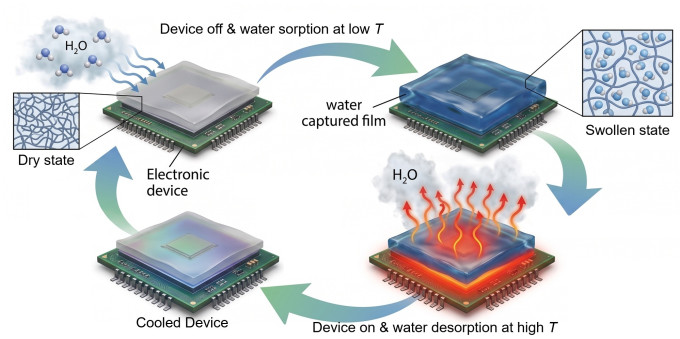
Operating principle of the passive cooling film. The film attached to an electronic device absorbs and stores moisture from the air, then releases it when heat is generated during device operation, continuously cooling the device. Provided by DGIST
The developed film maintains its adhesion and flexibility even when completely dry, allowing it to firmly stick to various surfaces such as metal, semiconductors, and glass. It absorbs and stores moisture from the air, and when the device generates heat, it evaporates the stored moisture, lowering the device surface temperature in real time. Even when it contains moisture, it does not corrode the device, so it can be attached directly to the surface of components without any additional coating process.
When its cooling performance was tested on operating electronic devices, the film stably reduced the device surface temperature by up to 18.2°C, from 72.3°C to 54.1°C, for more than 12 hours.
The research team stated, "These results show that the film can serve as a supplementary cooling device that alleviates the burden on existing electronic cooling systems, which consume large amounts of water and electricity," adding, "It can be used as an eco-friendly, high-efficiency energy-saving solution for the AI era."
Self-cooling films have emerged as a critical breakthrough for managing thermal loads in AI-era electronic devices. As artificial intelligence models demand sustained, high-intensity processing, AI chips and data center architectures generate immense heat densities that push traditional cooling systems beyond their limits. Self-cooling passive films offer an eco-friendly, zero-energy solution to this "thermal wall" without requiring electricity, pumps, or mechanical fans.
Recent breakthroughs utilize two distinct methodologies to solve electronic overheating: hygroscopic evaporative films and passive radiative cooling films.
1. Moisture-absorbing evaporative cooling films...A prominent breakthrough in October 2026 comes from a research team led by Professor Seong Kyun Kim at the Daegu Gyeongbuk Institute of Science and Technology (DGIST).
• The core mechanism: The film operates like a bio-inspired sweat system. It continuously extracts humidity from the surrounding ambient air even when dry. When the device undergoes intense AI workloads and heats up, the trapped water evaporates to absorb and carry the heat away in real time. When the device cools down, the film self-regenerates by re-absorbing moisture from the air.
• Material composition: It is an all-bio-based hydrogel combining nanocellulose (providing structure and immense moisture-holding capability) with hygroscopic organic ionic liquids (attracting water and ensuring flexibility).
• Thermal performance: Under continuous device operation, it consistently reduces surface temperatures by up to 18.2°C (from 72.3°C down to 54.1°C) with continuous cooling lasting over 12 hours.
• Key semiconductor advantage: Unlike historical moisture-based materials that are rigid and cause rust, this hydrogel remains highly adhesive and strictly non-corrosive when dry. It fits perfectly onto glass, semiconductors, and metals with zero air gaps.
2. Metamaterial passive radiative cooling films...Another dominant category includes ultra-thin metamaterial films that use the principles of photonics to reject and dump thermal energy.
• The core mechanism: These films work via a dual-action process. They block incoming ambient radiation/sunlight while simultaneously emitting internal device heat into the mid-infrared spectrum (the "atmospheric window"), effectively shedding heat into the cold sink of deep space with zero input power.
• Material composition: These typically consist of layered polymer structures embedded with nanoparticles (such as silicon dioxide, diamond microparticles, or boron nitride) to enhance both thermal conductivity and broadband infrared emissivity.
• Commercial integration: For example, Moguang New Energy—utilizing tech developed at Nanjing University—mass-produces atomic-layer radiative films for smartphones (adopted by brands like Apple and Xiaomi), which drops internal temperatures by 5°C to 10°C and boosts hardware reliability by up to 40%.
I need your help to continue doing this work (use the QR code above); thank you very much.


No comments:
Post a Comment