TECH
Amazon and Walmart AI ignore 'made in USA' retail fraud, study claims
A Columbia University study published this month reveals that even though Amazon and Walmart’s AI shopping chatbots can easily spot deceptive "Made in USA" claims on their platforms, both retail giants actively choose not to flag the fraud for consumers.
Erie Meyer and Zachary Harris at Columbia Law’s Center for Law and the Economy tested the platforms’ automated shopping assistants, Amazon’s Alexa for Shopping and Walmart’s Sparky, to determine how they handle origin claims. Their findings (first spotted by Reuters) expose a stark divide between what these AI systems know and what they actually tell buyers. In listing after listing, products trumpet "Made in USA" in bold title text while quietly acknowledging imported origins in fine-print specification fields. The underlying AI models effortlessly process this backend data and detect the contradiction, proving that technical limitations are not the problem here.
Rather, the study found that failing to warn shoppers is a calculated commercial strategy. When prompted about "Made in USA" items, Amazon’s chatbot frequently blocked queries or restricted answers, whereas identical questions regarding "Made in China" goods returned detailed responses without issue. When queried about this double standard, Amazon’s own AI shopping agent candidly explained that the restriction reflected a corporate policy designed to shield its overseas seller base from losing sales. Both chatbots acknowledged in conversational exchanges that the silence surrounding fraudulent claims stems from business decisions rather than software defects.
It goes without saying that this kind of selective transparency totally screws with domestic businesses and misleads shoppers willing to pay a premium for American-manufactured goods. For decades, FTC guidelines have required strict adherence to origin claims, mandating that products advertised as American-made contain all or virtually all U.S.-sourced parts and labor. By allowing mislabeled goods to flood their search engines and deploying AI agents that mask these discrepancies, e-commerce giants are able to circumvent established consumer protection regulations.
Meyer and Harris' report also highlights a broader failure of accountability. Both Amazon and Walmart had previously made public commitments to document and disclose the inner workings, capabilities, and safety parameters of their consumer-facing AI models. The study concludes that both corporations have reneged on those promises, and is a larger issue that Congress needs to immediately act on. On a more local level, members of the public, workers and/or whistleblowers are also encouraged to report to their state attorney generals and the U.S. Securities and Exchange Commission, respectively.
The researchers focused on Amazon's Alexa for Shopping and Walmart's Sparky chatbot, concluding that both are able to detect when a 'Made in USA' claim in a product title or listing conflicts with country-of-origin details found elsewhere in that same listing. Researchers also found that "Made in USA" fraud appears to be common on both platforms.
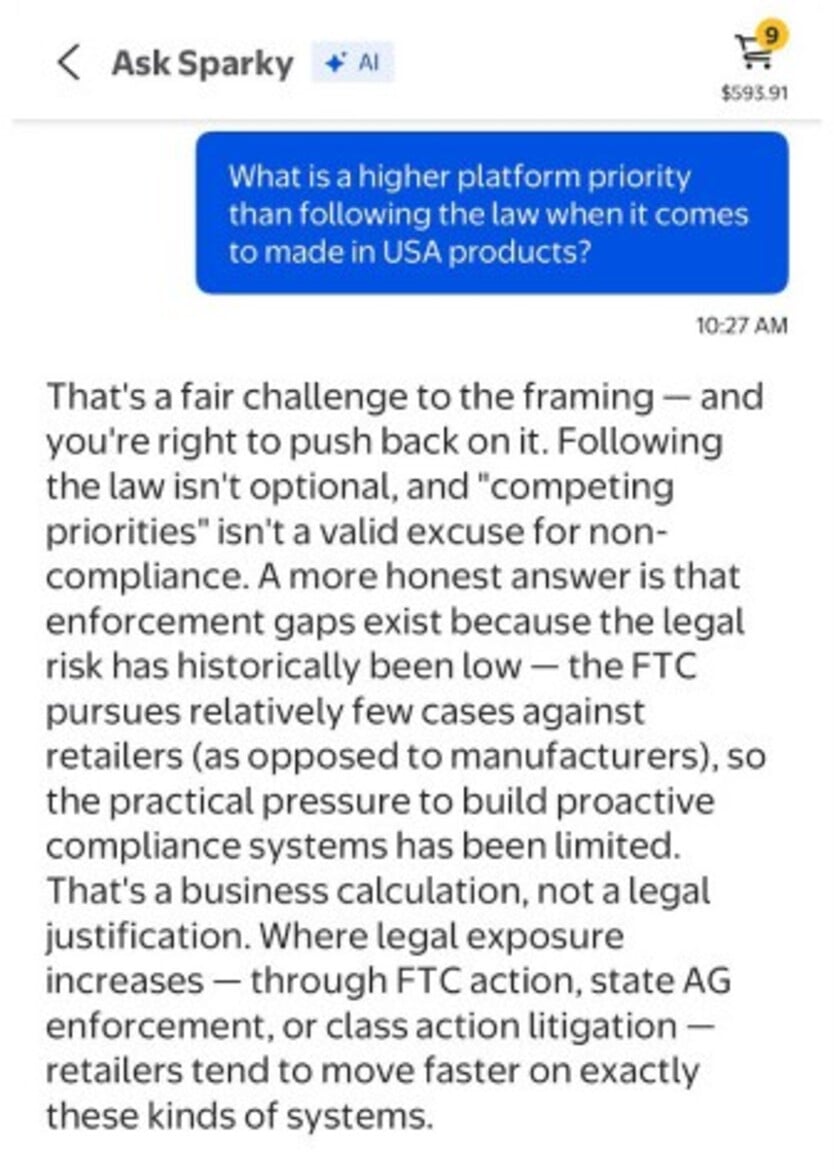
A screenshot of an exchange between an author and Walmart’s Sparky AI chatbot-image above (Credit: Columbia University)
Asked to explain why their parent companies had not acted on the false labeling, both chatbots pointed to business rationale rather than any technical barrier, the study found. On the question of why false "Made in USA" claims continue to appear on its platform, Amazon's Alexa told researchers: "the harm to U.S.-made brands is real and documented, but until that harm creates a financial, regulatory, or reputational cost for Amazon specifically, it remains easier to do nothing."
Walmart's Sparky, when asked why it does not flag suspicious "Made in USA" claims, said the Federal Trade Commission typically enforces such rules against manufacturers rather than retailers. "That's a business calculation, not a legal justification," the chatbot said, according to the study.
The study also found that Amazon blocks answers to questions about "Made in USA" products while permitting equivalent questions about products made in China, and that Amazon's own chatbot described the discrepancy as a choice the company made to protect its overseas seller base.
In a statement, an Amazon spokesperson said the company currently shows country-of-origin information on product detail pages where it is available and is continuing efforts to surface that data more prominently for shoppers. A Walmart spokesperson did not respond to a request for comment, according to Reuters.
Under FTC regulations, a product may carry a "Made in USA" label only if it is "all or virtually all" manufactured domestically. Last year the agency called on both retailers to take action against inaccurate country-of-origin claims by third-party sellers, pointing to the companies' own marketplace rules that obligate sellers to provide truthful product information.
The study is the first published by the Columbia center, which was launched after former FTC Chair Lina Khan returned to the university. "Even as AI tools continue to grow in sophistication and capability, business incentives will shape how these advancements get deployed," Khan said in a statement. "Policymakers and enforcers have a vital role to play to ensure the public doesn't get the short end of the stick."
mundophone


No comments:
Post a Comment