TECH
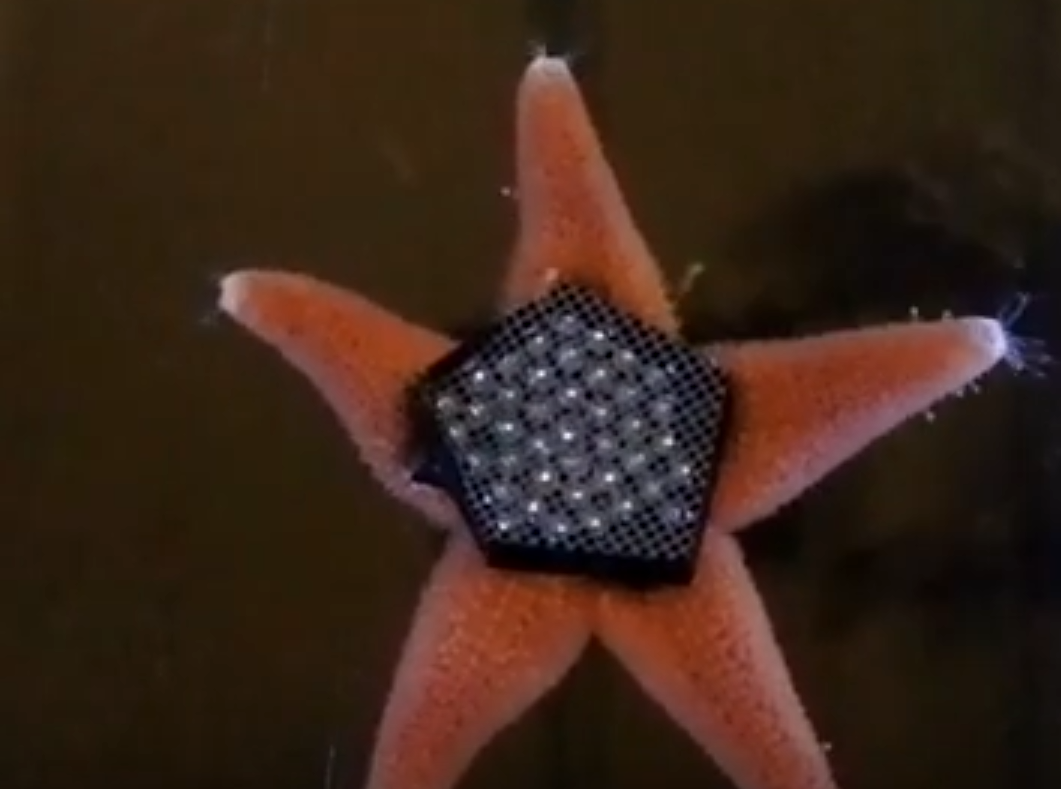
Robots that keep moving when flipped? Sea star tube feet offer a blueprint
Ever feel run off your feet? Spare a thought for sea stars, creatures whose movement involves the coordination of hundreds of tiny tube feet to navigate complex environments—despite the lack of a central "brain."
They move, climb and crawl across surfaces, all without a brain or a central nervous system. Starfish are at the center of a new study by an international team of biologists and engineers, showing their movement relies on a decentralized mechanism far more sophisticated than expected from a brainless animal.
Researchers found that starfish use hundreds of tiny tube feet that operate independently but in coordination. Each foot adjusts how long it clings to a surface based on load and the direction of gravity.
Laboratory experiments showed that starfish maintain a similar movement speed even when the number of active feet changes. By contrast, they slow down when each foot remains attached for a longer period.
The team demonstrated that this adaptation does not rely on any form of central control. Instead, each foot responds locally to its immediate conditions. The main conclusion is that starfish employ a smart movement strategy that allows them to cope with changing and challenging environments, all without a brain or a central control system.
From starfish to space. The Helix Nebula lies about 650 light-years from Earth and is considered one of the closest nebulae to our planet. In popular culture it is known as the ‘Eye of God’. The James Webb Space Telescope has recently provided an unprecedented view into the nebula, which was previously photographed by the Hubble Space Telescope.
In other words, it's as though each foot has a mind of its own. For Kanso Bioinspired Motion Lab, based within the USC Viterbi School of Engineering Department of Aerospace & Mechanical Engineering, sea stars pose an intriguing phenomenon. Kanso Lab specializes in decoding the flow physics of living systems, often applying those insights to inform developments in robotics.
Now, researchers at USC are uncovering the secret behind this decentralized locomotion. This could revolutionize how we design autonomous robots.
One thought per foot...The lab's recent paper in PNAS, Tube feet dynamics drive adaptation in sea star locomotion, reveals that the movement of sea stars is directed by local feedback from individual tube feet, each dynamically adjusting their adhesion to the surface in response to varying degrees of mechanical strain.
"We began working on sea stars with McHenry Lab at UC Irvine, and later partnered with biologists at the University of Mons in Belgium," said Eva Kanso, director of Kanso Lab and professor of aerospace and mechanical engineering, physics and astronomy. "Together with Associate Professor Sylvain Gabriele and graduate student Amandine Deridoux at the SYMBIOSE Lab, we designed a special 3D-printed "backpack" for the sea star. By loading and unloading the backpack, we could observe and measure how each tube foot responded to the added weight."
What did the researchers discover? Each foot responded independently to changing loads. "From the outset, we hypothesized that sea stars rely on a hierarchical and distributed control strategy, in which each tube foot makes local decisions about when to attach and detach from the surface based on local mechanical cues, rather than being directed by a central controller," said Kanso.
The experiments allowed the team to test and quantify these local responses. "At USC, we developed a mathematical model showing how simple, local control rules, coupled through the mechanics of the body, can give rise to coordinated, whole-animal locomotion."

No brain, no problem...This model for adaptive movement based on local feedback is highly relevant to the design of soft and multi-contact robotics. Potential application on land, under water and even on other planets, include decentralized locomotion systems for robots navigating uneven, vertical and upside-down terrain—environments that prevent consistent communication from a central "mission controller" or human decision-maker. No brain? No problem.
"We also conducted experiments in which we turned the sea star upside-down—the morphology of the tube feet allows the sea star to continue to move," said Kanso. "Just imagine if you were doing a handstand. Your nervous system would immediately let you know that you were in a position opposed to gravity. But a sea star has no such collective recognition."
Robustness through redundancy...Instead, the sea star is equipped with the local knowledge of each tube foot experiencing the force of gravity differently. Coordinated movement is due to the fact the feet are mechanically linked to the body; when one foot pushes, the movement affects other feet. As a result, local failures do not necessarily halt the whole system—allowing for advanced robustness and resilience.
That's a significant advantage for autonomous robots navigating extreme environments, liable to flip, lose or gain load, or be disconnected from central communication source. While fast-moving animals (from insects to gymnasts) rely on "central pattern generators"—specialized neural circuits located in the brainstem that produce rhythmic motor patters—slow-moving sea stars are primed to adapt dynamically to environmental changes.
So, it turns out there are some perks to being brainless. Whether a sea star is navigating tidal forces, currents or varying terrain roughness, they adapt and go with the flow.
Provided by University of Southern California


No comments:
Post a Comment