DIGITAL LIFE
Q&A: Fruit flies are a major source of inspiration in robotics
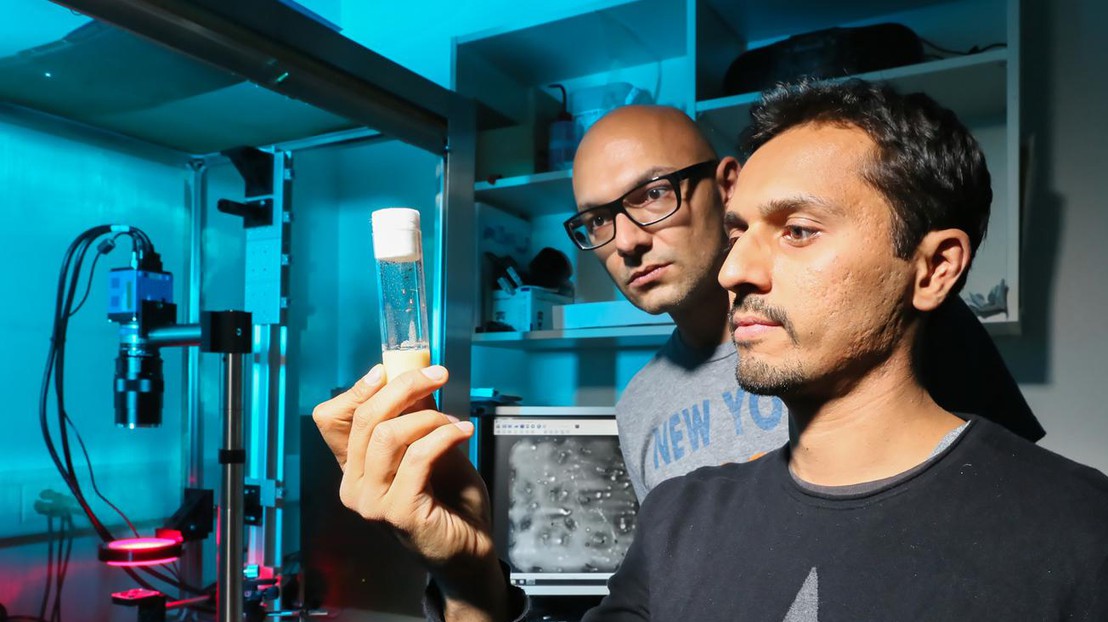
Researchers at EPFL's Neuroengineering Laboratory, led by Pavan Ramdya(on the right in the image above), aim to replicate the workings of the brain of the common fruit fly, Drosophila melanogaster. EPFL spoke with Ramdya about the exciting prospects for robotics.
On the screen, white on a black background, a fly is magnified thousands of times and walks calmly across a spherical surface on its six legs. "Watch, in a second it'll do the moonwalk." We are in the heart of the EPFL Neuroengineering Laboratory with Pavan Ramdya, head of the lab, and a postdoctoral researcher, Maite Azcorra. She shines tiny focused pulses of laser light at the fly using a technique known as optogenetics, which uses light to activate specific neurons. As if on command, the fly moves its legs backward. And it looks just like a dance.
Ramdya's 14-person research group has been studying the nervous system of these 2-millimeter-long insects since 2017. "Maite is currently studying how neurons that descend from the brain control motor functions," says Ramdya. The group hopes to eventually reverse-engineer the fly's brain and to model it for robotics.
One major step forward was the development of a digital twin that the researchers can use to accurately simulate a fly's behaviors; another was an important breakthrough in understanding how neural networks turn brain signals into coordinated movements. EPFL sat down in the office of the New York-born neuroscientist to talk about his work.
-Can you describe the general idea behind your research program?...Humans have been trying for centuries to build machines that can behave like animals or people. In Ancient Greece, for example, automated marionettes were quite common—these were simple objects but they were already a form of biomimetics, in that they imitated how an actual body moves. That's the same idea we're pursuing here, except that we use far more advanced methods and systems that can truly bio-mimic animals like the fruit fly.
-Why are you studying Drosophila melanogaster specifically?...There are more complicated animals of course, like mammals, but they're harder to study. And there are simpler ones like C.elegans, a worm with only around 300 neurons [flies have about 100,000 and humans have approximately 86 billion] but we can't learn as much about behavior from them. Unlike worms, flies have legs, and they do a lot with them—walk around, clean themselves, manipulate obstacles and more.
It's much more interesting for applications in robotics and neuroprosthetics to know how a creature with both wings and legs works. They're perfect specimens from that perspective: simple enough to study, yet complex enough to offer many insights.
-How might the work you're doing influence the development of robotics and AI?...Many engineers are working on the hardware side of robots—for example, batteries and motors. That's not our focus. We're seeking to design their controllers. With the idea of developing a robotic fly, our main point of interest is to understand how it can control its limbs. That's why we're studying the fruit fly's nervous system—to gain insights that will help us develop neural networks that can be used in robotics and AI.
I'd also point out that the robots using these controllers don't have to be the size of a fly. As long as it is scaled appropriately, they can be any size—even as big as a house, although that would be a little scary!
-What are currently the biggest hurdles to developing systems that can learn by exploring their environment?...One hurdle is to create algorithms that can process sensory data. If they can't contextualize these data, it would be very difficult for machines to learn the appropriate behaviors. It's important to stress that the solution does exist—it's just hidden in animals' nervous systems. That's what we're trying to uncover. Instead of spending decades attempting to design a solution from scratch, why not look at what already exists in flies?
-Will that necessarily be an easier and faster approach?...What we'll probably need is a combination of different approaches. Especially since animals have a lot of constraints and objectives that aren't relevant for our purposes. For instance, robots don't need to be able to reproduce or defecate.
That's why we must also include biologists in our work and not just engineers. They are better able to know which parts of an organism we can ignore, such as neurons used to evacuate food, so that engineers don't focus on them. An interdisciplinary approach is essential for the work that we're doing.
-Is the goal to eventually map the human brain?...I'll have to give you a selfish answer: for me, personally, that's not my goal. I have around 40 more years to live if I'm lucky, and I'd really like to see major breakthroughs in my lifetime that could show how biological systems work. That seems possible with the fruit fly, but it would be far more complicated for the human brain.


No comments:
Post a Comment