DOSSIER
INTEL
Company records significant financial loss
After the close of trading, Intel's share price dropped 8.23% yesterday as the company ended the second quarter with a serious decline in revenue, not meeting analysts' expectations. A net loss of $454 million didn't please investors either, but Intel's CFO tried to reassure the public that the bottom has already been hit, and further the company's financial performance will only improve.
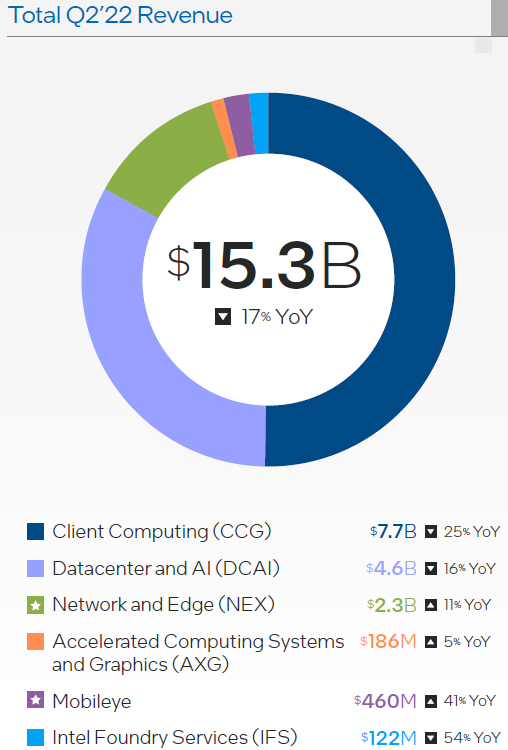
Furthermore, Intel's profit margin has consistently dropped from 50.4% to 36.5%, eloquently illustrating rising costs and falling revenues. Intel's total revenue for the last quarter was down 17% or even 22%, depending on the calculation method, to $15.32 billion. This is 14% less than analysts had expected and is an anti-record in terms of market expectations for the period since 1999.
The company's CEO, Patrick Gelsinger, said at a quarterly event that the sudden and sharp decline in customer economic activity was the main reason for the company's revenue decline in the reporting period. At the same time, Intel had to spend impressive amounts of money developing new products, developing new technologies, and bringing discrete graphics solutions to market. The shortage of semiconductor components still prevents Intel from fully supplying the market with its products, even if the bottleneck is not the company's own capacity.
With a reprioritization of spending, Intel expects to return profit margins and free cash flow to desired levels in the second half of the year. Gelsinger did not miss the opportunity to speak about the company's achievements in the second quarter. So far, more than 35 million Alder Lake processors have been shipped using Intel 7 technology, which in the old hierarchy was considered the latest generation of 10nm process technology. The company is ready to start serial production of products based on Intel 4 technology in the second half of this year. The development of Intel 3, 20A and 18A technologies, according to the head of the company, is done according to schedule or even ahead of schedule. This fall, the company expects to start creating digital designs for multiple products at once.
Since Gelsinger's return to Intel in February of last year, he noted, a decision has been made to close operations in six areas, freeing up about $1.5 billion to invest in the IDM 2.0 strategic program. The current tense economic environment does not diminish Intel's desire to return to technology leadership by 2025 and achieve lithographic parity with competitors as early as 2024. Overall, computing revenue for Intel customers declined 25% year-over-year for US $7.7 billion, operating profit dropped 73% to $1.1 billion and operating profit margin shrank from 39% to 14%. The company blames the consumer and education segments for the drop in demand for PCs, as well as the presence of increasing inventories from manufacturers. Rising production costs Intel calls it one of the factors that influenced the fall in operating income in the second quarter. At the same time, the average processor sales price in the second quarter increased by 11% due to a shift in demand to more expensive models in the desktop and mobile segments.
The company expects to start shipping Raptor Lake processors in the current semester and introduce Meteor Lake processors next year. The Raptor Lake family will debut in the desktop segment this fall and will be introduced to mobile devices later in the semester, providing a double-digit percentage increase in performance over Alder Lake and processor socket-level compatibility. Meteor Lake processors will be released on Intel 4 technology in 2023, their samples are already working both in the company's own labs and on its customers' side.
The PC market capacity, according to the forecasts of the head of Intel, will decrease by 10% in 2022, although demand weakness is less pronounced in the higher price segment and in the corporate sector. In the second quarter, according to company management, Intel customers received fewer components than they would have required had there not been an increase in inventory. They will cut them at a record pace, according to Gelsinger, and therefore, in the second half of the year, the supply of PC components could grow again. Overall, annual PC sales are expected to remain at more than 300 million units, and the number of computers older than four years has already reached 600 million units, and they are subject to modernization in the near future.
Overall, Intel's customer computing revenue fell 25% year-over-year to $7.7 billion, operating profit fell 73% to $1.1 billion, and operating profit margin shrank from 39% to $14 billion. %. The company blames the consumer and education segments for the drop in demand for PCs, as well as the presence of increasing inventories from manufacturers. Rising production costs Intel calls it one of the factors that influenced the fall in operating income in the second quarter. At the same time, the average processor sales price in the second quarter increased by 11% due to a shift in demand to more expensive models in the desktop and mobile segments.
The company expects to start shipping Raptor Lake processors in the current semester and introduce Meteor Lake processors next year. The Raptor Lake family will debut in the desktop segment this fall and will be introduced to mobile devices later in the semester, providing a double-digit percentage increase in performance over Alder Lake and processor socket-level compatibility. Meteor Lake processors will be released on Intel 4 technology in 2023, their samples are already working both in the company's own labs and on its customers' side.
Intel has already started digital designs for Granite Rapids chips that will be built using Intel 3 technology, but this is a server product, not a consumer product. In the current quarter, engineering samples of Granite Rapids from the first stage are already planned to be launched on the test bench.
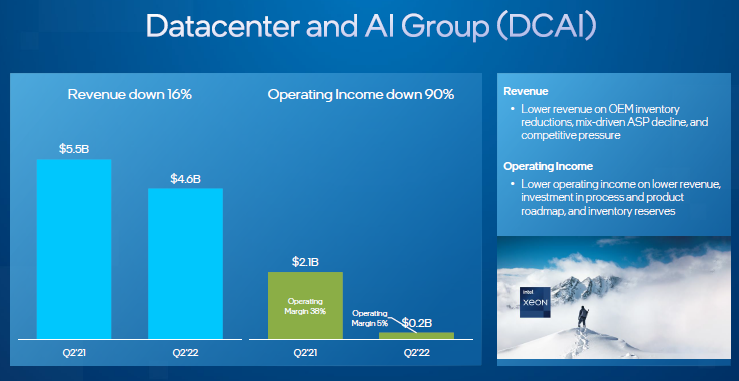
In the server segment, things are still not so bleak. In the second quarter, the company had to deal with a drop in server revenue of 16% to $4.6 billion, but in the long term, Intel's management expects revenue growth in the segment of 15-16%. per year. Second-quarter operating profit in the server segment declined 90% to $0.2 billion, and operating profit margin shrunk from 38% to 5%. Among the negative factors, the company attributed the drop in the average sale price of processors for servers under the influence of changes in the demand structure, in addition to competitive pressure. The profitability of the activity is also reduced by the need to invest in the development of new products and in the development of new lithographic patterns.
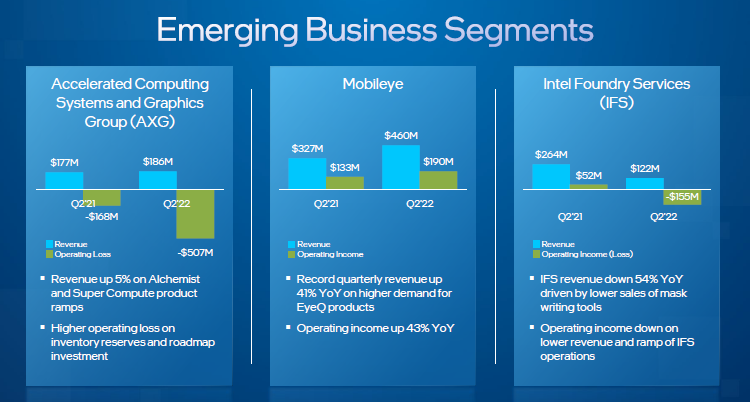
Intel had to admit that this year the company won't be able to hit the previously planned numbers for the number of GPUs shipped, but in terms of revenue they will exceed $1 billion by the end of the year. Starting in Q2, Arc Mobile discrete graphics solutions are shipped to leading laptop manufacturers. In the third quarter, the company will begin shipping Arc A5 and A7 discrete desktop graphics cards. This year, Intel also expects to ship several million Blockscale mining accelerators, although this was not originally planned. In the graphics direction, Intel's revenue for the year increased 5% to $186 million, but operating losses increased from $168 million to $507 million, for the company this type of activity is still not profitable.
Demand for components for Mobileye's active driver assistance systems enabled the company to increase core revenue by 41% to a record $460 million, while operating income increased 43% to $190 million. go public this year. Finally, the contract line of business, isolated in the new reporting framework, brought Intel no more than $122 million in second-quarter revenue, which is 54% less than a year ago. The company's $155 million operating loss is partly attributed to high expansion costs for the contracts business, as well as lower demand from automakers that have had to deal with shortages of other components.
But by the way, Intel can boast of having agreements not only with MediaTek, but also with six of the top ten chip developers in total, among which there are already customers for the 18A process technology. The company has already formed contractual obligations of $6 billion, more than 30 customers are preparing to receive the first engineering samples of their products from Intel. Early next year, the company expects to complete the acquisition of Tower Semiconductor.
Intel CFO David Zinsner added that before the end of the year, the company will not only have to limit new hires but also reduce capital spending. By the end of the year, according to him, a recession scenario could materialize in the global economy, and the impact of the pandemic should not be fully amortized. By the end of this year, Intel expects to earn $65 billion to $68 billion, down from its previous forecast of $76 billion. In the second half, Intel's revenue in the customer area may grow, although in general, by the end of the year, market capacity is expected to decrease by 10%. The company will end the period with negative free cash flow in the range of $1 billion to $2 billion.
By the fourth quarter, Intel expects to increase the profit margin to at least 51%, but by the end of the year it will still not exceed 49%. Finally, the company's capital expenditures must be reduced from $27 billion to $23 billion, which will not prevent shareholders from simultaneously holding dividends to shareholders at $1.5 billion per quarter. In just three quarters, the company will pay out more than $4.5 billion in dividends, and with a $4 billion cut in capital expenditures, that seems kind of wasteful, but not in the eyes of shareholders. In the third quarter, the company expects to earn $15 billion to $16 billion. The current quarter's profit margin will be on the order of 46.5%.
According to Intel's CFO, the second and third quarters of this year in terms of financial performance will be the “bottom” from which Intel can exit to grow further. The company's shares reacted to such statements and the publication of statistics with a devaluation of 8.23%.
AVnews




No comments:
Post a Comment