TECH
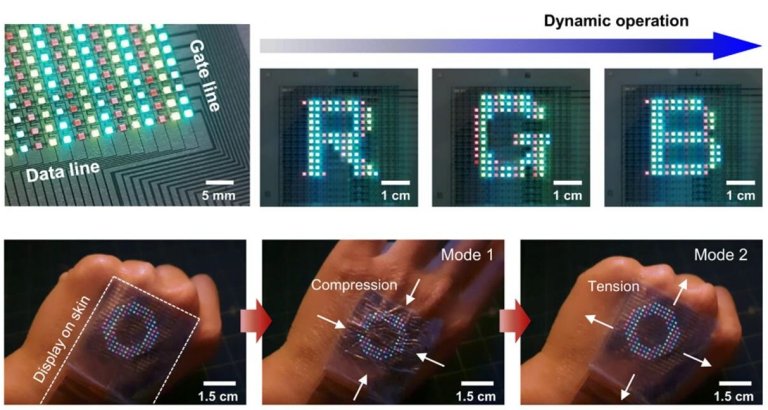
A screen integrated into the skin
Screen for skin
"Wearable" electronic devices - which include electronic clothing and skin-gluing devices - already have very complex sensors and circuits, but nothing better than a screen to show results.
A team from Cornell University, USA, has just created a screen tailored just for these thin and flexible equipment.
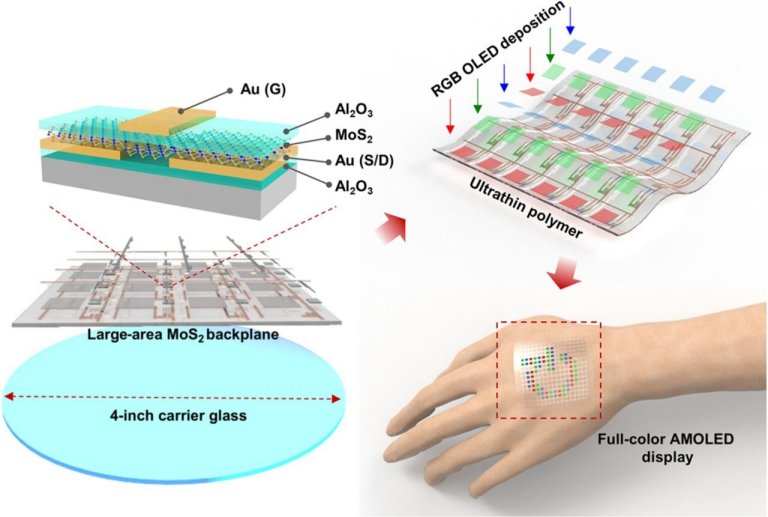
It is an active matrix screen made with organic LEDs, or OLEDs, that is completely flexible and built on a biocompatible polymer.
Kibum Kang and his colleagues started by building the control circuit, an array of thin-film transistors on a two-dimensional film of molybdenite (molybdenum disulfide, or MoS2) that was then transferred to a surface of PET (polyethylene terephthalate) and oxide of aluminum (Al2O3).
Next, the red, green and blue OLED pixels were deposited, presenting excellent properties, both in terms of brightness and energy consumption, as well as mechanical.
Atomically thin screens
The prototype has 324 pixels distributed on a screen of two
inches, still a low resolution compared to traditional screens, but more than enough to show simple health monitoring results, for example. In addition, the screen is capable of showing the full color palette.
In fact, the efficiency of the circuit - both of the molybdenite transistors used in the control and of the OLED pixels - has achieved such good results that the team believes it has laid the foundation for a new class of thin, flexible displays that could have wide use.
"With the use of these films, we have successfully demonstrated batch manufacturing on the wafer scale of high performance MoS2 monolayer field effect transistors with a device yield of 99%, and fabrication at various levels of transistors stacked vertically for three-dimensional circuits. Our work is a step towards the realization of atomically thin integrated circuits, "wrote the team.
Bibliography:
High-mobility three-atom-thick semiconducting films with wafer-scale homogeneity
Authors: Kibum Kang, Saien Xie, Lujie Huang, Yimo Han, Pinshane Y. Huang, Kin Fai Mak, Cheol-Joo Kim, David Muller, Jiwoong Park


No comments:
Post a Comment