TECH

AI-powered holographic display could bring Star Trek-style 3D images closer
Sci-fi holodecks and floating 3D projections just took a meaningful step closer to reality. In a study published earlier this month, researchers at the UCLA Samueli School of Engineering and the California NanoSystems Institute (CNSI) unveiled a method for projecting complex 3D scenes in a single shot, using a blend of artificial intelligence and physical light-programming optics.
Led by Dr. Aydogan Ozcan, the UCLA team took aim at one of the most stubborn bottlenecks in holographic display development, a problem the researchers call dense depth multiplexing.
To build a convincing three-dimensional image out of light, engineers typically slice a 3D object into layers and project those layers at different depths at once. As the depth layers pack closer together to create a solid, fluid illusion, the light waves bleed into one another. This phenomenon, known as diffraction-induced cross-talk, blurs the images and erodes depth selectivity, working against the natural focus cues that make a 3D display comfortable to look at in the first place.
Conventional fixes leaned on heavy computation or on time-sequential scanning that assembles the volume one slice after another, an approach that makes real-time 3D projection slow and power-hungry.
The UCLA solution is a hybrid digital-optical design that splits the workload between code and physical optics. At the front end sits a digital encoder, a neural network that does much of its work in the frequency domain. It reads the target scene across depth, pulls out features at several scales, tags each layer with its axial position, and compresses the whole stack into one phase pattern that the optics can later unpack.
That pattern then feeds a diffractive decoder, a passive stack of optical surfaces whose structure was shaped by machine learning. As light travels through the custom surfaces, the structure itself steers each image to its assigned depth and damps the bleed between planes. Notably, the team found that simply throwing more resolution at the encoder was not enough on its own. The learned optical decoder did the decisive work of pulling adjacent depths apart.
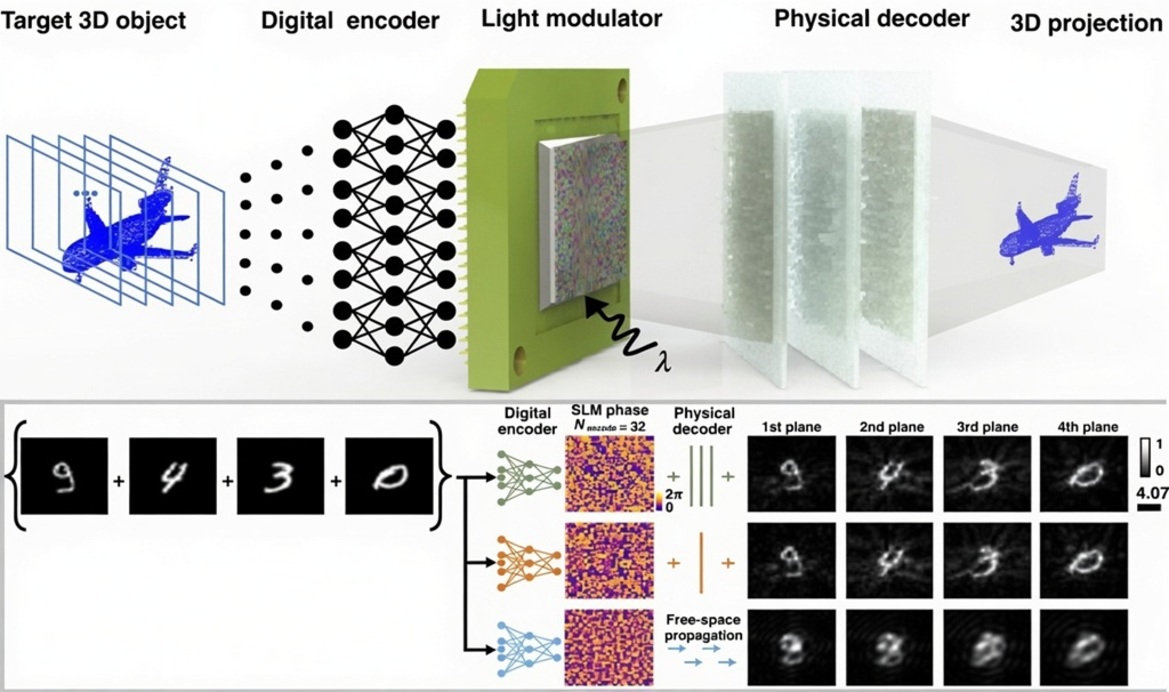
Schematic and numerical simulation results of the diffractive snapshot 3D display architecture(image above)
The results are striking. In numerical simulations, the system scaled up to volumetric scenes built from 28 distinct depth slices, holding separation between layers at distances on the order of a single wavelength of light, though fidelity softened slightly for slices buried in the middle of the stack. The researchers also showed the projection planes could be repositioned on demand rather than locked to fixed depths.
To prove the concept was more than a digital exercise, the team built a physical prototype that runs in visible red light at 650 nanometers. That setup paired the encoder with a single-layer decoder to project two depth planes, and the captured intensity patterns closely tracked the simulations while clearly beating a free-space setup with no decoder at all.
What makes the approach attractive for consumer electronics is its efficiency. Because the diffractive decoder is entirely passive, it bends and filters light without drawing any power of its own, moving work that would otherwise hammer a processor into the optics themselves. The team did flag a trade-off worth watching, since pushing for brighter output raised the diffraction efficiency but reintroduced speckle and cross-talk, leaving a balance to strike between brightness and clarity.
By easing the computational and energy demands tied to depth-resolved 3D projection, this light-programming framework could help pave the way for compact near-eye AR/VR optics, volumetric microscopy, and real-time 3D visualization. For now the researchers frame the work as a proof of concept, with multi-layer fabrication, full-color operation, and viewer-facing systems still on the road ahead.
mundophone


No comments:
Post a Comment